
RYEGRASS, RODENTS & THE FIRST REAL FEEL OF FALL
October 4 - 10, 2026
Growing Grass in the Desert Starts Here
QUICK STATS
Year-to-Date Rainfall: 17.36 inches
Rainfall: 0.17 inch BELOW normal
24-Hour Average Soil Temperature: 79°F
5-Day Average Soil Temperature: 84.8°F
Rainfall measured at BES-TEX Supply, 4512 Adobe Dr., San Angelo, Texas.
Soil temperature information is tracked using Syngenta GreenCast.
GOOD MORNING, OCTOBER
This morning finally felt like fall.
It was about 65 degrees outside, and this is probably my favorite time of year to stand outside with a cup of coffee and enjoy the morning.
Of course, our West Texas weather had to remind us where we live. For most of the past five days we were told rain was coming. At one point we had around an 80% chance.
And what happened?
Nothing.
Welcome to West Texas.
Our rainfall total stands at 17.36 inches, just 0.17 inch below normal. We would certainly take another good rain, but we know the deal. We live here, we adjust, and we keep moving forward.
October isn't about trying to squeeze another summer out of our landscapes. It is about preparing them for winter.
YOUR OCTOBER CHECKLIST
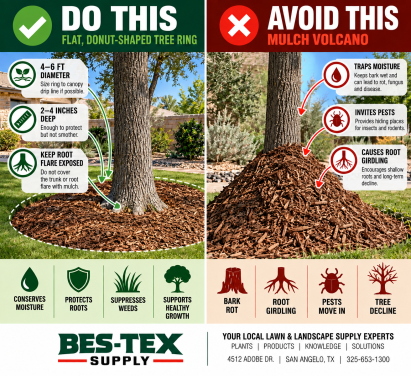
• MULCH YOUR BEDS Mulch helps conserve moisture and moderate soil temperature. Keep it away from tree trunks and root flares. Think "donut," not "volcano."
• CLEAN THINGS UP Remove unwanted overgrowth, weeds and debris, but don't assume everything needs a hard pruning just because October arrived.
• ADJUST YOUR IRRIGATION Cooler temperatures and shorter days mean lower water demand. Your landscape doesn't need July's watering schedule in October.
• FINAL FERTILIZATION If your warm-season lawn still needs its final feeding and is actively growing, we're at the end of that window. Our 21-7-14 contains 50% slow-release nitrogen from sulfur-coated urea plus 5% iron. The objective now is healthy turf, not excessive late-season top growth.
• KEEP LEAVES OFF THE TURF Don't allow a heavy layer to smother the lawn going into dormancy.
• CHECK IRRIGATION Fix broken heads and leaks before freezing weather eventually arrives.
• DECIDE ABOUT RYEGRASS If you want green turf this winter, now is the time to prepare.
Here is a good Texas example of what we mean by proper mulching. Keep the root flare exposed rather than piling mulch against the trunk.
GOING INTO WINTER HEALTHY
You've probably heard me say:
"The healthier we go into winter dormancy, the better our spring greenup should be."
There is some real plant science behind that.
While Bermuda is still actively photosynthesizing, it is building and storing carbohydrates in its crowns, stolons, rhizomes and roots. Those reserves help the plant survive winter and support new growth when spring returns.
We're not trying to force a bunch of green top growth before winter. We're trying to send a healthy plant into dormancy.
RYEGRASS, IS IT TIME YET?
Almost, but watch the soil temperature.
Our 24-hour average is 79°F and our 5-day average is 84.8°F.
University turf research recommends overseeding as average daily soil temperatures consistently fall below approximately 72°F. So we're getting closer, but our current numbers tell me to GET READY rather than simply planting because the calendar says October.
ANNUAL OR PERENNIAL?
GULF ANNUAL RYEGRASS
50 lb bag $53.40
Annual ryegrass is our economical option. It establishes rapidly and provides winter green, but generally has a coarser texture and lighter color. It also usually makes spring transition easier. (AggieTurf)
FUTURA 2000 PERENNIAL RYEGRASS
50 lb bag $131.00
Perennial ryegrass gives you the premium appearance, finer texture, darker green color and better traffic tolerance. The tradeoff is that it can persist longer in spring and compete with Bermuda during transition. (AggieTurf)
Here is the type of dense winter turf we're talking about when Bermuda is overseeded with perennial ryegrass:
PREPARATION IS EVERYTHING
Good seed-to-soil contact is one of the keys to successful overseeding.
Mow the Bermuda low, remove the clippings and excess debris, open heavy thatch if necessary, spread the seed evenly in two directions and begin your establishment watering.
And remember, more fertilizer isn't necessarily better.
Our 12-24-12 starter fertilizer is $42 for a 50-lb bag. Around the store, we've traditionally used a simple planning rule of approximately TWO BAGS OF SEED TO ONE BAG OF STARTER.
That is a convenient estimating rule, not the proper fertilizer rate for every lawn. University turf research has also cautions against excessive nitrogen during overseeding because it can continue stimulating the warm-season turf.
DID YOU APPLY PRE-EMERGENT?
This is important.
We've spent September talking about fall pre-emergent.
If you recently applied pre-emergent where you now want ryegrass, STOP BEFORE BUYING SEED.
Many pre-emergent herbicides can prevent ryegrass from successfully establishing too. Prodiamine, pendimethalin and other products have specific reseeding restrictions.
Tell us WHAT you applied and WHEN you applied it. We'll look at the actual label before you spend money putting seed on the ground.
The label controls, not guesswork. University turf research has also warns that many pre-emergence herbicides interfere with overseeded ryegrass.
And remember, ryegrass comes with a spring bill. That beautiful green lawn in January eventually has to transition back to Bermuda. Perennial ryegrass in particular may require active spring removal so Bermuda can recover.
HERE COME THE RODENTS
Something else happened at BES-TEX this past week.
Our rodent-control sales increased.
That doesn't surprise me.
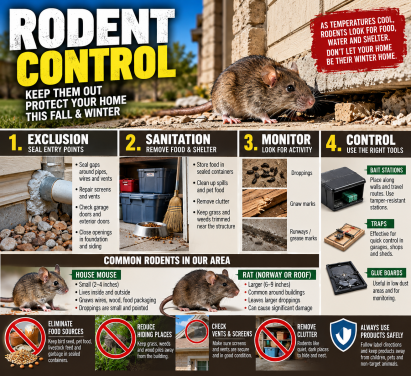
As the weather changes, mice and rats look for protected places with food, water and shelter. Garages, barns, shops, storage buildings and our homes can provide all three.
But don't start with the bait.
START WITH THE BUILDING.
Look around garage doors, exterior doors, pipes, utility penetrations, vents and foundations. Remove food sources and clutter. Look for droppings, gnawing and travel routes.
Then put your traps or bait stations where the rodents are actually traveling, often along walls and protected edges. We recommends combining sanitation, exclusion, trapping and properly used rodenticides rather than depending on a single control method.
This is the type of exterior bait-station placement we're talking about, close to the structure and along a likely rodent travel route:
At BES-TEX we carry Bell Laboratories products including Contrac, Final, Fastrac, Liqua-Tox II, traps, glue boards and bait stations.
Different rodent problems require different approaches. Tell us what you're seeing and where you're seeing it, and we'll help you build a program rather than simply selling you a bucket of bait.
Always use rodenticides according to the label and protect children, pets and other non-target animals.
CLOSING THOUGHTS
October may be one of my favorite months in West Texas.
The mornings feel better, the coffee tastes a little better outside, and after our West Texas summer, I think we have earned a little cooler weather.
But October is also about preparation.
Prepare the lawn for dormancy. Adjust the irrigation. Clean up the landscape. Decide whether ryegrass is right for you. And apparently the mice are making their winter preparations too, so don't let their plan include moving into your house.
Enjoy the cooler mornings, keep watching the soil temperature, and keep watching that rain forecast, even if West Texas doesn't always cooperate with it.
We live here. We adjust. And we keep moving forward.
Happy Sunday , everyone.
BES-TEX Supply
4512 Adobe Dr.
San Angelo, TX 76903
325-653-1300