[Skip to Content]

Sandburs, beat the next burr.

BES-TEX Best Management Practices · Sandbur

Know it. Crowd it out. Time the next flush.

Sandburs, beat the next burr.

Know the plant. Prevent the next flush.

Got burs already?

A spray will not remove the stickers that are already there. Stop spreading them, then prevent the next flush and treat new seedlings early.

Know the plant

Sandbur (grassbur) is a grassy weed in the genus Cenchrus. Texas sources commonly discuss field sandbur (C. spinifex, also treated in older literature as C. incertus), longspine sandbur (C. longispinus), and southern sandbur (C. echinatus). Product labels do not all use the same species name, so identify the plant before choosing a treatment.

Each bur usually holds one to three seeds and clings to shoes, pets, tires, and mowers. Burs mean the plant has reached seed production — not that it is dead, and not that a spray will sterilize the burs already formed.

An annual completes one life cycle: it grows, reproduces, and dies. Its seeds start the next generation. That is different from perennialization. Some Cenchrus species, including C. spinifex, can persist from a living crown after winter. A preemergence herbicide does not control plants that already survived.

What to do now: Wear gloves. Collect small patches of burr-bearing material without scattering it into clean turf. Bag clippings when plants are seeding.

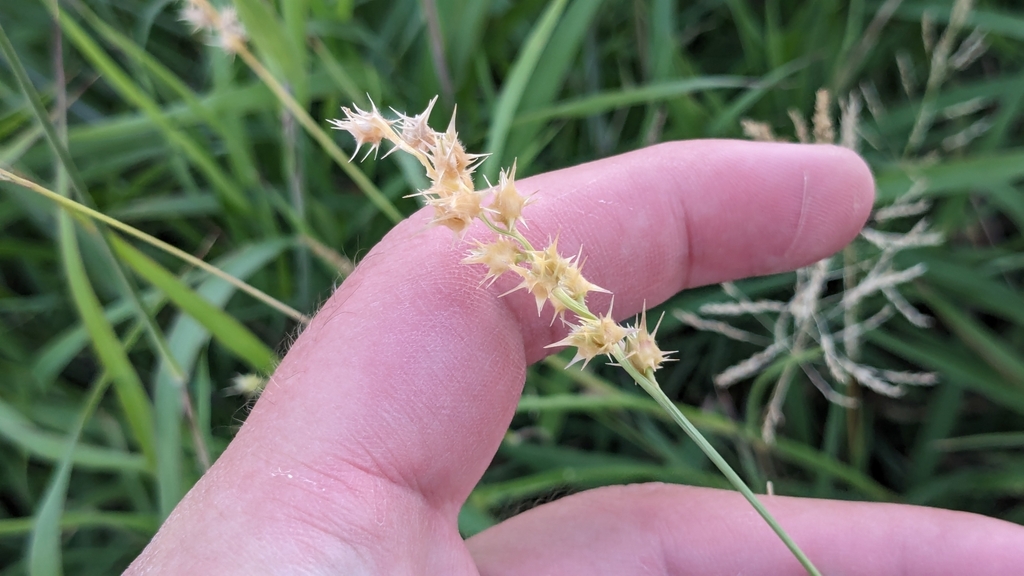
Sandbur photographed in San Angelo, Tom Green County, Texas, by Joseph Aubert
Sandbur, San Angelo, Tom Green County, Texas, June 12, 2024. Photo: Joseph Aubert / iNaturalist · CC BY 4.0 · No image edits. Recorded as Cenchrus spinifex; genus Cenchrus is supported. Species-level community confirmation is pending. This is not a research-grade identification.

Prevent with better grass

A dense, healthy lawn is the foundation. Sandbur is adapted to sandy, dry, low-fertility sites, but it is not limited to poor soil.

  • Soil-test instead of guessing at fertilizer.
  • Mow at a height suited to the grass; do not scalp.
  • Water deeply and less often, not with frequent light sprinkling.
  • Improve the desired grass over more than one season. Competition helps; it does not guarantee elimination.

Simple seasonal timing

1 · Before seedlings

Start preemergence early

Apply a labeled preemergence herbicide before seedlings appear. Watch soil temperature and moisture — not a single calendar date.

2 · Make it work

Activate, then split only by label

Activate each application with rainfall or irrigation as that product’s label directs. If a second application is used, follow only that product’s interval and seasonal limits. There is no universal 14-day split.

3 · Keep scouting

No temperature finish line

Texas A&M turf publications describe germination beginning as average daily soil temperatures warm, then generally peaking later. Published wording differs on whether germination slows, pauses, or continues at low levels in summer heat. A later flush can occur. Do not treat one reading as proof that every plant is up. Scout and treat new seedlings while they are small.

Match the product to the grass and the site

Herbicide options, used carefully.

Only products verified from manufacturer-hosted labels and SDS retrieved November 8, 2026, are named here. Those copies are not independently confirmed as the latest revision. The container label in hand controls. No rates are given. University pasture trials are not lawn authorization. Texas A&M also discusses other PRE actives, including dithiopyr and pendimethalin; Dimension and Pendulum products are omitted pending that same verification.

PRE · Lawns

Specticle FLO

Labeled for established warm-season turf, including residential lawns. Its weeds list includes sandbur as Cenchrus longispinus — not automatically every Cenchrus species. Identify the plant.

Needs rainfall or irrigation to activate before germination. It does not control plants emerging from existing rootstocks, so a perennialized crown can escape a PRE program.

Use extra care on very sandy or gravelly soils. New seed, sprigs, sod, and reseeding intervals are restricted. Common or off-type bermudagrass may be more sensitive than hybrids. St. Augustinegrass has a lower labeled maximum than bermudagrass, zoysiagrass, or buffalograss.

POST · Lawns

Celsius WG

Lists field sandbur (Cenchrus incertus) for established residential turf. Target young, actively growing weeds. Mature, hardened-off plants may not be controlled. It will not remove existing burs.

Intended for foliar application by licensed commercial applicators. Buying it does not authorize do-it-yourself use.

Use only label-listed tolerant cultivars; examples are under the table. Test other cultivars first. Temporary discoloration can occur on stressed turf. Do not use on bahiagrass, seashore paspalum, or cool-season turf (fescues, Kentucky bluegrass, perennial ryegrass, creeping bentgrass). Keep people and pets out until sprays dry. Above 90°F, St. Augustinegrass spot treatments may temporarily regulate growth; do not add a spray adjuvant.

POST · Pasture / hay only

Pastora

Not for residential lawns. The label says do not use on lawns, walks, driveways, tennis courts, golf courses, athletic fields, or other high-maintenance or fine turfgrass areas. A Bermuda home lawn is still a lawn.

Discussed here only for label-approved established bermudagrass pasture and hay meadows — not every range or pasture grass. The bermudagrass must have been established for at least one growing season.

For sandbur, apply when plants are newly germinated up to 1.5 inches tall; larger or overwintered plants may only be suppressed. Bermudagrass should be less than 4 inches tall after spring green-up or hay cutting. Allow at least 16 days between applications, and follow count and annual limits.

Grass / site Specticle FLO (PRE) Celsius WG (POST) Pastora (POST)
Bermudagrass lawn Labeled cultivars; common or off-type may be more sensitive Labeled cultivars No — a home lawn is still a lawn
St. Augustinegrass Labeled cultivars; lower labeled maximum than Bermuda Labeled cultivars; heat and adjuvant caution No
Zoysiagrass Labeled cultivars Labeled cultivars No
Buffalograss Labeled Legacy and Cody listed; test other cultivars No
Established Bermuda pasture / hay Not this lawn product No Yes, if the label site and stage fit

Celsius WG tested-cultivar examples: Bermuda — Tifway 419, Common, Tifsport, Discovery, Celebration, Sahara; St. Augustine — Floratam, Palmetto, Bitter Blue, Common, Amerishade, Raleigh, Sapphire, Delmar, Captiva; zoysia — Meyer, Empire, Crown, Palisades, Cavalier, Zorro, DeAnza, Zenith; buffalograss — Legacy, Cody. Specticle FLO also lists named cultivars on its label.

Essential cautions

  • Read the current container label and SDS before any use. Documents retrieved November 8, 2026, are not a latest-revision guarantee. No rates are printed here.
  • MSMA is not a residential-lawn option. Labeled golf-course and sod-farm uses do not make it a home-lawn product.
  • Inspected Q4 and Q4 Plus labels contain quinclorac but do not list sandbur; do not recommend them for sandbur. 2,4-D alone is a broadleaf herbicide; sandbur is a grass.

Bring a sample. Tell us the site.

A lawn and a hayfield need different plans. Bring your grass type, photos, and the exact site.

Sources

  1. Howard & Nolte, Texas A&M AgriLife, Grassbur/Sandbur Management in Turf (SCSC-PU-265, 2024).
  2. Nolte & Howard, Texas A&M AgriLife, Grassbur/Sandbur Identification and Management in Pastures and Hayfields (SCSC-PU-258, 2023).
  3. Envu, Celsius WG manufacturer-hosted label (retrieved Nov. 8, 2026).
  4. Envu, Specticle FLO manufacturer-hosted label (retrieved Nov. 8, 2026).
  5. Envu, Pastora manufacturer-hosted label (retrieved Nov. 8, 2026).

BES-TEX Supply, LLC

4512 Adobe Dr., San Angelo, TX 76903 · 325.653.1300
BES-TEX Best Management Practices · Sandbur