

BES-TEX Supply, LLC
325.653.1300
BES-TEX Best Management Practices · Lawn Disease
Take-All Root Rot in St. Augustine
A homeowner’s guide for San Angelo and Central West Texas
Fix the stress first. Prevent, don’t chase.
Take-all root rot is a soil fungus common in Texas lawns. It rots roots and runners when St. Augustine is stressed, often showing at spring green-up or in summer heat. Lawn care comes first; fungicides protect, they don’t cure.
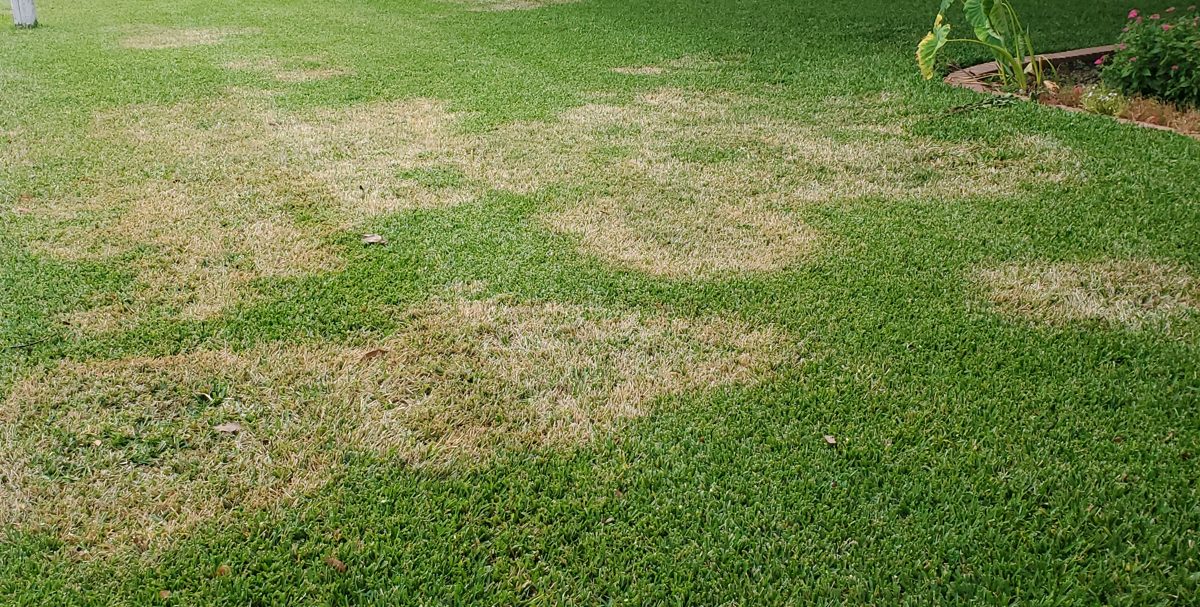
Look at the roots, not just the leaves
Signs
Yellow leaves, then thinning, irregular brown patches 1 ft to 20+ ft across.
Pull test
Tug runners at a patch edge. Take-all roots are short, black and rotted.
Look-alikes
Brown/large patch, chinch bugs, grubs and iron yellowing need other treatments.
Lawn care comes first
M · Mow high
St. Augustine at 3–4 in, the top setting or one notch below. Never scalp.
W · Water deep, less often
Fix drainage, low spots and overwatering. Wet areas stay prone.
F · Feed lightly
Use ammonium-based nitrogen, no more than 1 lb N per 1,000 sq ft per feeding.
A · Aerate & dethatch
Core-aerate while the grass is growing. Thin thatch thicker than ½ in.
Peat moss topdressing
Spread about one 3.8 cu ft bale of sphagnum peat moss per 1,000 sq ft, once or twice a year. In Texas A&M trials on Dallas lawns, peat protected St. Augustine for about two years.
Prefer not to use peat? Ask about Carboniz PN, a compost and biochar soil enhancer sold as a peat alternative. A 40 lb bag covers up to 2,000 sq ft. This is a product option, not take-all research.
From our counter: BES-TEX experience, not research
Our soils
San Angelo lawns typically run pH 8–8.5, and St. Augustine struggles there.
pH Master 6-0-2 (50% sulfur including elemental sulfur, 10% iron, ammonium nitrogen)
A product we like. Apply in January–February: sulfur can go down any month here, and January gets it into the soil ahead of busy April. The elemental sulfur is what can acidify; sulfur works slowly, over months, so it needs a head start. Its ammonium-sulfate nitrogen fits our ammonium-nitrogen advice. Bag rate: about 50 lb per 3,000 sq ft (about 17 lb per 1,000 sq ft).
Peat moss
We stock 3.8 cu ft bales. The research rate is one bale per 1,000 sq ft; at the counter we think that's on the light side.
Carboniz PN (50% compost, 50% biochar)
A counter favorite, sold as a peat alternative. Its label says it conditions soil and adds organic matter, at 20–40 lb per 1,000 sq ft on lawns. It is not a fungicide.
Fungicides prevent. They don’t cure.
Best before symptoms
Results are inconsistent once grass is yellow; no fungicide brings back dead grass.
Azoxystrobin has the best research support
We carry Heritage G (0.31% azoxystrobin granules). Its home-lawn directions list take-all patch at 2–4 lb per 1,000 sq ft, 28 days apart, and name St. Augustine.
Skip straight propiconazole for take-all
It showed no benefit on Dallas St. Augustine lawns. Combo granules like Strobe Pro G (azoxystrobin + propiconazole) are labeled for take-all patch, but adding propiconazole gave no extra benefit there.
Water it in right away
with ¼–½ in of water so it reaches the roots (Texas A&M). Liquid azoxystrobin needs a calibrated sprayer; ask at the counter.
San Angelo timing (estimate)
Fall
2 applications, mid-September to late October, 28 days apart
Spring
2 applications after green-up, 28 days apart (label: typically April–May)
Bring a picture or a sample.
Bring photos, or a patch-edge sample with roots and soil in a zip-top bag, to 4512 Adobe Dr. We’ll look at it with you before you buy anything.
Read the full research
Take-All Root Rot research report (20 pages, PDF).
Download the research report Printable one-page BMP
Sources: Texas A&M AgriLife Extension; Colbaugh et al., Texas A&M Dallas peat moss studies (2003, 2005); EPA labels: Heritage G 100-1323 (2025), Strobe Pro G 53883-440 (2024).