
Happy Sunday the 13th, friend!
Your Lawn Has a History. Are You Writing It Down?
I took a look at our San Angelo soil-temperature chart Saturday morning. If you feel like this heat has been hanging on, take a look at that blue line.
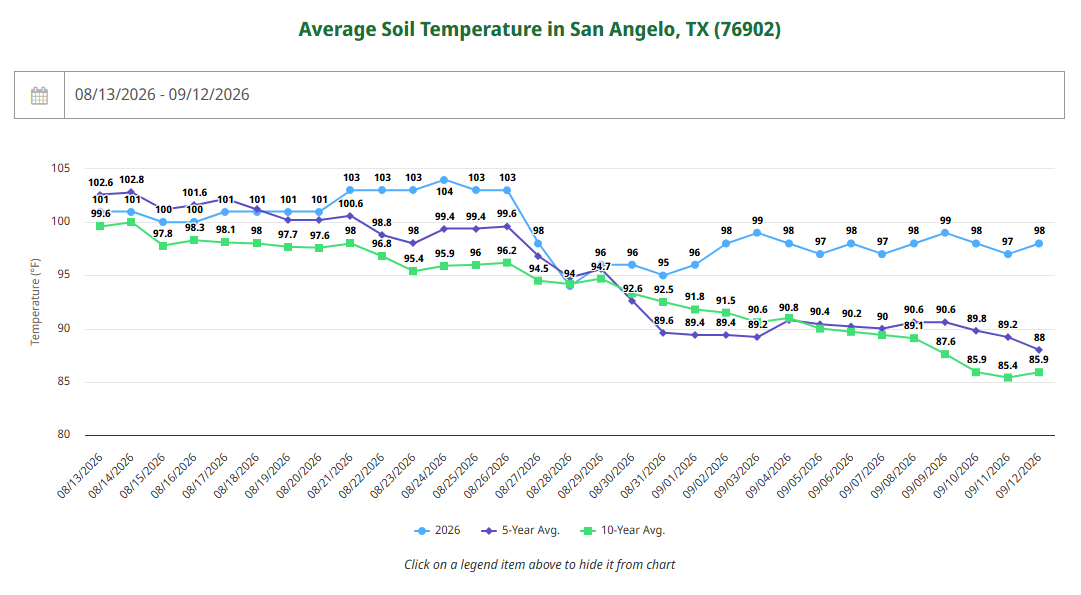
The blue line is 2026, purple is the five-year average, and green is the ten-year average.
On September 12, our soil temperature was 98°F, compared with 88°F on the chart’s five-year average line. The ground is cooling from its late-August highs, but it is still holding a lot of heat.
This has been a hot summer well beyond San Angelo. NOAA reports that summer 2026 was the hottest on record across the contiguous United States. Texas also received less than 30% of its average rainfall in August. That is a statewide number, not a measurement of your yard, but it helps explain why heat and dry conditions are on everybody’s mind. We have had hotter years in San Angelo before, so I am not calling 2026 our hottest year on record. NOAA’s August climate report, National Weather Service San Angelo heat records
September’s To-Do list
A lot happens in the lawn and landscape this time of year:
-
Plan fall pre-emergent. September is the month we talk about preventing winter weeds, including the rescuegrass we see so often here. A pre-emergent must be applied before its target weeds germinate. Check the grass type, timing, and label. LSU AgCenter on fall weed prevention
-
Thinking about new sod? Choose the right grass, prepare the ground, check sprinkler coverage, and allow time for roots to establish before cold weather. Tell us about that plan before applying pre-emergent, since products have different restrictions for newly planted turf.
-
Look ahead to fertilizer. It is getting close, but the right choice depends on your grass, its condition, and what you have already applied.
-
Inspect trees and shrubs. If you find an insect problem, identify the pest before choosing a treatment. A systemic insecticide is not an automatic fall chore, and product labels and pollinator precautions matter. Oregon State Extension on systemic insecticides
-
Check your equipment. A sharp mower blade and a properly working sprayer or spreader can make as much difference as the product you choose.
Now for the question behind this week’s Insight: Which of those jobs will actually make it onto your Done list?
Know your starting point
Before we put together a lawn plan, I want to know four things:
What grass do you have? How many square feet is your lawn? What does it look like today? What do you want it to become?
Around here, that grass may be common Bermuda, hybrid Bermuda, Zoysia, St. Augustine, or fescue. If you are unsure, bring us a close-up of the blades and runners, or a small sample. Grass type affects mowing height and which products can safely be used.
Give your lawn a score from 1 to 5. A 1 has major bare areas or serious problems. A 2 is thin, patchy, or weedy. A 3 is a healthy, everyday lawn. A 4 is thick and mostly uniform. A 5 is that carefully maintained showcase lawn.
Then choose the number you want. There is nothing wrong with aiming for a three. Not everybody wants to spend the time, water, and money it takes to maintain a five. A lawn that is a two aiming for a five also needs a different plan from a lawn that is already a four.
Move it from To Do to Done
Every time you finish a job, write down five things:
Date. What you did. Product and amount, if any. Where you did it. What happened afterward.
It can be as simple as: “September 14, mowed front-yard Bermuda at 1½ inches. Cut looks even, no scalped areas.”
If you applied a product, record its name, rate, the square footage treated, and when you watered or had rain. Take a photograph from the same spot each month. That gives us something far more useful than, “I think I put something out last fall.”
New to lawn care? Start with those five notes. Experienced? Add your soil test, irrigation amounts, application equipment, and before-and-after pictures.
Your To-Do list this week: Identify your grass, measure your lawn, pick your current and desired score, and take one picture.
Your Done list: Write down what you actually completed.
Bring that information to BES-TEX when you have a question. We can give you much better advice when we know not just what you planned to do, but what happened in your yard.
A better lawn comes from doing the right work at the right time, then learning from the results.
A couple of things before I go
If you’ve been thinking about buying a mower, come see me. We still have Scag, Hustler, and Walker mowers on the floor, and I would rather put one to work for you than keep it here all winter. Bring me a reasonable offer. I’m ready to talk, and this may be your best opportunity to make a deal this year.
I also have an immediate opening at our parts counter. I need someone who can help customers find what they need, keep the parts organized, and follow through on the little things that make a store run right. If you have parts experience, I’d like to hear about it. If you’re organized, good with people, and willing to learn, I’d like to hear from you too. Stop by BES-TEX and let’s visit.
Monte
325-234-5142 text me.
monte@bes-tex.com