
Week 43: Oct 18 – 24, 2026
EQUIPMENT & IRRIGATION, PLUS WHAT'S GOING OUT THE DOOR
Growing Grass in the Desert Starts Here
QUICK STATS
|
Measure |
This week |
|---|---|
|
Year-to-date rainfall |
17.36 inches |
|
Compared to normal |
1.07 inch BELOW |
|
24-hour average soil temperature |
87.4°F |
|
5-day average soil temperature |
83.8°F |
Rainfall measured at BES-TEX Supply, 4512 Adobe Dr., San Angelo, TX.
Soil temperature tracked using Syngenta GreenCast.
GOOD AFTERNOON
There comes a week every fall when the mower sits a little longer between cuts. The grass is slowing down, the mornings are cooler, and the yard doesn't need you every Saturday anymore.
Think about what that mower did for you this summer. It started in triple-digit heat, ran through dust and stickers, and came back every week asking for nothing but gas. It's earned a little care before it rests.
This is our second-to-last Weekly Insight of the year. Last week I promised we'd talk about your equipment and your sprinklers, so let's get to it.
EQUIPMENT & IRRIGATION
Here's the thing about small engines. They don't forget how you treated them in October. They just wait until March to tell you about it.
Your mower: put it up right, and it starts right.
Here's what we see every March. A mower that ran fine in October sits all winter with old gas in it. Then on the first warm Saturday, it won't start.
Most of the time, it's the fuel. Pump gas can start going stale in as little as 30 days. The ethanol pulls water out of the air, and what's left turns to varnish in the carburetor. I'm not a fan of pump gas, and I'm not a fan of leaning on a stabilizer to save it. A stabilizer slows the gas from going bad, but in my opinion that's a band-aid on fuel that's already prone to trouble. I'd rather start with gas that doesn't go bad in the first place.
Here's how I do it. Run the old gas out of your mower. Then put in a quart of VP 4-cycle fuel and run it a few minutes, so the VP is in the carburetor before you store it. VP is ethanol-free, so there's no ethanol pulling in water and no varnish building up. It's good when you pull the mower out in spring. We carry VP 4-cycle in quart, gallon, two-and-a-half, and five gallon.
AI illustration, BES-TEX Supply
Before you park it:
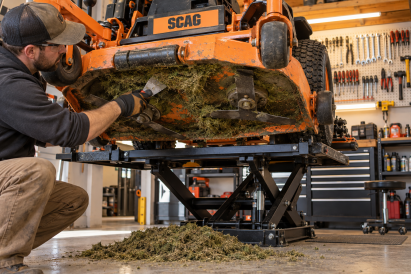
- Clean the deck. Wet grass packed under there rusts it from the inside out.
- Change the oil while the engine is warm. Old oil sitting in the engine all winter does it no favors.
- Sharpen and balance the blades.
- Check the air filter and spark plug.
- Grease the fittings and check the tire pressure.
- Keep the battery charged on a maintainer, or pull it and store it inside. A dead battery can freeze and crack. A charged one won't.
- Put it in a shed or garage, or at least cover it. Keep the sun off it. Our West Texas sun cracks seats, fades paint, and dries out tires, belts, fuel lines and plastic parts. That goes for your trimmers and blowers too.
Zero-turn owners: the right oil, at the right time.
The drive system on your zero-turn runs on oil, and here's where folks get in trouble. The manual calls it the "hydraulic system," but what goes in it is not hydraulic fluid. On the SCAG Tiger Cat II and the Hustler Super Z, it's 20W-50 motor oil.
We've had mowers come into our shop with hydraulic fluid poured in the reservoir. It's too thin for these transmissions, and it did real damage. Not sure what goes in yours? Check the manual or ask us before you pour anything.
That oil works hard in our heat. Both manuals say the same thing: change it once a year or every 500 hours, whichever comes first.
So which comes first for you? Look at your hour meter.
- Homeowners: A lot of homeowners put somewhere around 30 to 40 hours a year on a mower. At that pace, you'd need over 12 years to reach 500 hours. Once a year is your schedule.
- Commercial crews: Even at 300 hours a year, the one-year mark still comes first. You'd have to run more than about 10 hours a week, every week of the year, to hit 500 hours before the calendar does.
Here's the bottom line. For almost everybody, it's once a year.
Why change oil you've barely used? Because it's not just the hours. Heat and time break oil down, and our summers run these transmissions hot. A few quarts of oil and a filter cost a lot less than a hydro pump. And if you ever need a warranty claim, you'll want to show it was maintained by the book.
In between changes, check the level. SCAG says every 200 hours or monthly. Hustler says every 50 hours or weekly. A brand-new Hustler also needs its first oil and filter change at 50 hours.
Residential models can run on different transmissions with different schedules, so check your owner's manual. Or bring it in this winter, and we'll take care of it.
Trimmers, blowers and saws.
Mixed two-stroke fuel goes bad even faster. For anything with a two-cycle engine, I recommend VP 2-cycle year round, not just for storage. Run it in before you put the equipment up for winter. We carry it in the same sizes: quart, gallon, two-and-a-half, and five gallon.
Clean the air filter. Check the spark arrestor screen on the muffler, because a clogged one robs you of power. Sharpen the chain on your saw before you hang it up.
And don't store gas or equipment next to a water heater or anything with a pilot light.
Beat the spring rush.
Here's my honest wish for you. Every spring, the first warm week fills our shop. Everybody wants their equipment back at the same time, and the season has already started. I truly wish folks would bring it in now, in the winter, when our shop isn't buried.
Right now the line is short. Bring yours in now, and it'll be ready before you need it. We have pickup and delivery on the brands we sell. And we sharpen every Wednesday, drop it off and pick it up Thursday. That's mower blades, chainsaw chains, pruners, hedge clippers, just about anything with an edge.
We work on the brands we sell: ECHO, shindaiwa, STIHL, SCAG, Walker and Hustler. That way the parts are on our shelf, not on a truck somewhere.
Irrigation: cut it back, then protect it.
Shorter days and cooler nights mean your lawn uses a lot less water than it did in August. If your controller is still on the summer schedule, you're watering the street.
- Cut your run times back, and check the soil before you water.
- Water in the morning. Night watering on cool nights invites disease.
- Check your rain sensor and freeze sensor, if you have them.
- Don't shut it off for good. If we go a month without rain, your trees and dormant Bermuda still need a deep drink. Moist soil also holds heat better than dry soil going into a freeze.
- Overseeding? New ryegrass needs light, daily water until it sprouts.
AI illustration, BES-TEX Supply
Before the first hard freeze:
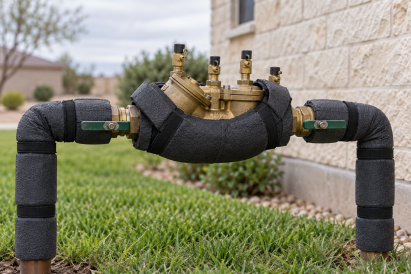
- Wrap your backflow preventer. It sits above ground, and it's usually the first thing to freeze and split.
- Pull the hoses off the outside faucets. A hose left on traps water right where it can freeze.
- Insulate any exposed pipes.
A split backflow in January is a wet, cold, expensive mess. Fifteen minutes now saves you that phone call.
WHAT'S GOING OUT THE DOOR
Ryegrass. Once the soil holds under about 72, it's go time. Seed has to touch dirt. Seed sitting on top of thatch isn't a lawn, it's bird feed. Mow your Bermuda low, rake down to soil, then seed and put down your starter fertilizer. Water lightly every day until it sprouts. Gulf Annual is $53.40, Futura 2000 Perennial is $131.00, and 12-24-12 starter fertilizer is $42.00, all 50 lb bags. [CONFIRM PRICES]
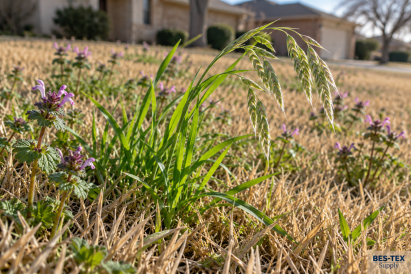
Winter weeds. The henbit, chickweed, burclover and rescuegrass you'll be cussing in March are sprouting right now. Pre-emergent isn't too late, but don't put it where you're overseeding. It can't tell a weed from ryegrass.
AI illustration, BES-TEX Supply
Large patch. Brown circles in St. Augustine with an orange ring at the edge? Pull a blade at the edge. If it slides out rotted at the base, that's large patch. Water in the morning, skip the nitrogen until spring, and bring us a sample in a sealed bag.
Fire ants. Fall is a great time to bait them. Put it out on dry ground with no rain expected for a day or two, and use fresh bait. Stale bait is like day-old coffee. The ants won't touch it.
CLOSING THOUGHTS
Put the gas up right, clean the deck, and get your mower in before the spring line forms. Cut the sprinklers back, wrap the backflow, and pull the hoses off the faucets.
Next week, Week 44, is our last one of the year. We'll take one final walk around the landscape, put everything into one last checklist, and cover what needs attention before the colder weather sets in. Then we'll close out this year's Weekly Insight and pick back up in February. Until then, we've still got some good weeks ahead of us, so let's make them count.
Happy Sunday, Fun Day.
BES-TEX Supply 4512 Adobe Dr. San Angelo, TX 76903 325.653.1300