
WEEDS
Colubrina Texensis
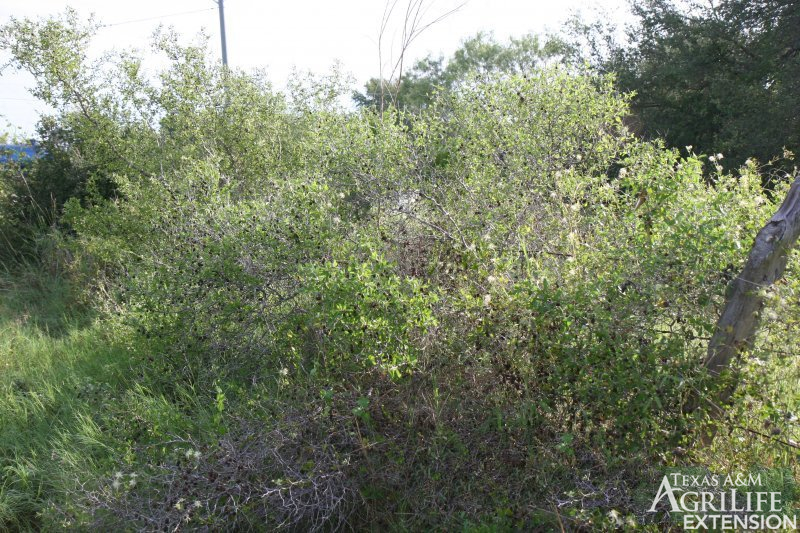


Texas Snakewood / Texas Hog Plum
Colubrina texensis
Woody perennial shrub
Foliar Spray (Broadcast or Spot Spray)
Best Timing
-
Late spring through summer
-
Plant must be actively growing
-
Good soil moisture
-
Avoid drought stress and cold fronts
Herbicide Options & Rates
Triclopyr (ester or amine)
-
1.0 - 1.5% solution
-
1.3 - 2.0 quarts per 25 gallons of water
-
-
Add 0.25% non-ionic surfactant
Triclopyr + 2,4-D
-
1.0% Triclopyr + 1.0% 2,4-D
-
Improves leaf burn and translocation
Pasture Systems (if labeled)
-
Aminopyralid + 2,4-D
-
Use mid-label rate, not minimum
Expected Percent Control
-
First application: 60 - 75%
-
Second-year follow-up: 80 - 85%
-
Poor timing or drought can drop control below 50%
Key note: Foliar works best on plants under 5 - 6 ft tall.
Basal Bark Treatment (Most Reliable)
Best Timing
-
Late summer through winter
-
Can be done year-round
-
Does NOT require active leaf growth
Herbicide & Rate
Triclopyr ester
-
20 - 30% solution
-
1 quart triclopyr ester per 3 - 4 quarts basal oil or diesel
-
Application Technique
-
Spray lower 12 - 18 inches of trunk
-
Wet bark thoroughly
-
No runoff
Expected Percent Control
-
Single treatment: 85 - 95%
-
Proper coverage is the difference between 70% and 95%
This is usually the best recommendation for fence lines and individual plants.
Cut-Stump Treatment (High Confidence Control)
Best Timing
-
Any time of year
-
Works even during dormancy
Herbicide & Rate
Triclopyr (concentrate)
-
20 - 30% solution
-
Apply immediately after cutting
Application Technique
-
Cut flush with ground
-
Treat entire stump surface, especially outer edge
Expected Percent Control
-
90 - 98%
-
Delays or skipping treatment drops control fast
What Customers Need to Hear (Plain Talk)
-
Mowing alone = 0 - 20% long-term control
-
Foliar spray = moderate, timing dependent
-
Basal bark = most dependable
-
Cut-stump = nearly permanent if done right
Snakewood wins when people under-dose or mistime it.
Simple Counter Recommendation
-
Scattered small plants: Foliar spray at 1 - 1.5%
-
Fence lines / single plants: Basal bark at 25%
-
Big woody clumps: Cut-stump + triclopyr
BES-TEX Supply
4512 Adobe Dr.
San Angelo, TX 76903
325.653.1300
Benefits of Using Pre-Emergent Herbicide on Your Lawn
Introduction: Pre-emergent herbicides are a valuable tool for maintaining a healthy and weed-free lawn. Applied before weed seeds germinate, these products prevent weeds from establishing themselves, leading to a cleaner and more vibrant lawn throughout the growing season.
Benefits:
-
Weed Prevention: Pre-emergent herbicides create a barrier in the soil that inhibits weed seed germination. This means fewer weeds sprouting up in your lawn, reducing the need for manual weeding later on.
-
Long-lasting Control: Properly applied pre-emergents can provide control for several months, effectively targeting weeds at their earliest stage of growth.
-
Preserve Lawn Health: By preventing weeds from competing with your grass for water, nutrients, and sunlight, pre-emergent herbicides help your lawn stay healthy and lush.
-
Cost Efficiency: Investing in pre-emergent herbicides can save money on labor-intensive weed control methods and lawn restoration.
-
Environmental Benefits: Targeted application reduces the need for broad-spectrum herbicides, minimizing environmental impact.
Application Tips:
-
Timing is Key: Apply pre-emergents before soil temperatures consistently reach the optimal range for weed seed germination, typically in early spring or fall.
-
Even Coverage: Ensure uniform application to maximize effectiveness. Follow manufacturer instructions regarding application rates and methods.
-
Watering In: Water the product lightly after application to activate it within the soil.
Conclusion: Using pre-emergent herbicides is a proactive step towards maintaining a weed-free lawn, promoting healthier turf growth, and reducing maintenance efforts throughout the season.
Discover the Benefits of Pre-Emergent Herbicides. Prevent weeds before they sprout and enjoy a healthier, more vibrant lawn. Visit BES-TEX Supply for expert advice and products.
Start your weed prevention today! Call 325.653.1300 or visit us at 4512 Adobe Dr., San Angelo, TX 76903
Best Management Practices:
King Ranch Bluestem
King Ranch Bluestem (KR Bluestem) is a perennial grassy weed that shoots up a seed head on a long stem within a couple of days after mowing. The seed head formation is usually a purplish/maroon color that has several small branches that form the shape of a hand. Another good characteristic is the fuzzy hair at the nodes on the foot long stem.
Unfortunately, pre-emergent herbicides alone will not control this perennial weed. Remember, this plant comes back from its roots each year, so it will take both pre-emergent and post-emergent herbicides to take out King Ranch Bluestem from your lawn. Pre-emergent herbicides kill germinating seeds while post-emergent herbicides only control weeds that are already actively growing. So make sure that you select your herbicide carefully.
Unfortunately there are no post-emergent herbicides that are labeled for controlling this weed in St. Augustinegrass. The only solution is to do one or a combination of the following: dig out the King Ranch Bluestem by hand; use pre-emergent herbicides like Balan 2.5 G, Crabgrass Control or Pendulum 2G.
KR Bluestem can be extremely invasive in Pastures and Costal Bermuda Fields. KR Bluestem begins to emerge from the root structure when the soil temperatures reach 60 degrees and the seeds will germinate at 70 degrees. Pastora Herbicide, by Bayer, has been shown to be effective in the control of KR Bluestem when used in accordance with the Product Label during mid summer, i.e. in July and again in September. Applications should be made after Cutting, baleing and the removal of hay. The KR Bluestem will be the first growth to appear after hay has been cut. Application rate is one ounce per acre plus surfactant. Control is most effetive when applied both in July and again in September. The maximum application of 2 1/2 ounces per season is recomended.
All Pesticides must be used in accordance with the Manufaturers Product Label.
Best Management Practices courtesy of:
Bes-Tex Supply, LLC P.O. Box 664 San Angelo, Texas 76902 Ph. 325-653-1300

Best Management Practices:
Bluegrass
Annual Bluegrass, referred to as Poa Annua is a cool season, annual grassy weed that normally has small white seed heads and a canoe-shaped leaf. Annual Bluegrass comes back from seed each year, usually germinating in the early fall season. Annual bluegrass creates havoc in lawns because it will germinate seeds throughout the winter as well. Annual bluegrass begins its life by germinating in the fall from seed. Pre-emergent herbicides work by killing germinating seeds from weedy plants like annual bluegrass. Normally, an application of a pre-emergent in early/mid September will work well. A second pre-emergent application in November may be needed.
There are several pre-emergent herbicides that can be used to control annual bluegrass in most turfgrass sites including bermudagrass, St. Augustinegrass, zoysiagrass, and buffalograss. Examples include Pendulum 2G or Anderson 11-3-11 (Pendimethalin) and Balan 2.5 G (Benefin).
If you have annual bluegrass that escapes the pre-emergent or you do not apply a pre-emergent, you may need to apply a post-emergent herbicide. Post-emergent herbicides can be effective if used when the annual bluegrass is very young/immature and actively growing. Examples of effective products are Revolver and Certainty. These products works very well if used in the correct manner and it may require multiple applications. CAUTION: Read the labels carefully for the tolerance level of your specific turfgrass for all herbicides.
Best Management Practices courtesy of:
BES-TEX Supply, LLC P.O. Box 664 San Angelo, Texas 76902 325.653.1300

Best Management Practices:
Spreading Dayflower
Spreading dayflower is a rather unique plant that grows in moist areas in Texas. It is a warm season, annual lily-like herb that has parallel-veined, alternate, lance-shaped leaves. The flowers of dayflower are blue in color with three petals and normally only last one day—hence the name. Being a warm season, annual plant means that it comes back from seed each year, usually germinating in the spring season and possibly into the summer. Dayflower can also propagate from stem fragments as well.
The best defense against weeds like dayflower is a healthy, dense turf---and it takes all of these components to create this beautiful, weed-free lawn that you desire.
Dayflower begins its life by germinating in the spring from seed. Pre-emergent herbicides work by killing germinating seeds. Unfortunately, this particular weed is relatively tolerant to most pre-emergent herbicides. So, trying to control dayflower this way may be frustrating. An application of a pre-emergent in late February and May can help, but ultimately you will need to control dayflower with post-emergent herbicides.
The most effective way to control spreading dayflower is with post-emergent herbicides. These herbicides can be effective if used when the dayflower is very young/immature and actively growing. Trimec Southern and Weed Free Zone are excellent choices to control dayflower. Each of these works very well if used in the correct manner. Make sure you READ THE LABEL very carefully prior to application. It may require multiple applications to obtain excellent control with these post-emergent products. CAUTION: Make sure you read the labels carefully for the tolerance level of your specific turfgrass for all herbicides.
Best Management Practices courtesy of:
Bes-Tex Supply, LLC P.O. Box 664 San Angelo, Texas 76902 Ph. 325-653-1300